In the Use Case Open-air museum – Hinge, the focus is the digital capture and conservation of a historical hinge as an exemplary component. The aim is a scalable workflow from 3D capture through model-based design to reproducible repair or remanufacture.
Use Case 2
Overview
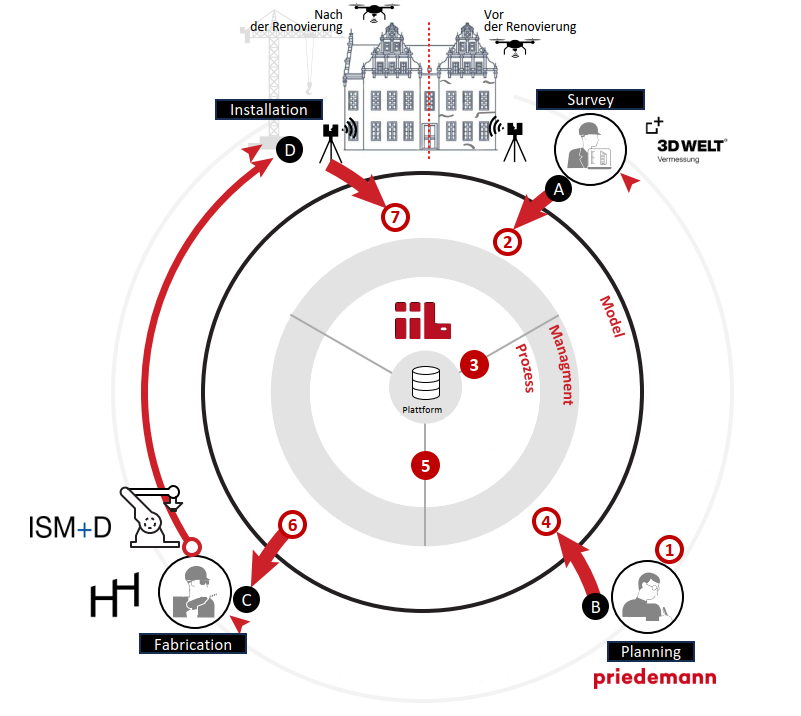
Process map
Move over a process area to highlight the corresponding lifecycle step.
From survey record to building memory
The use case is structured around traceable component data: capture, decide, fabricate and write back.
Survey
TLS, photogrammetry and photographs document the façade and detail parts. The resulting data forms the first component-level record.
Planning
HBIM variants, damage assessment, repair decisions, tolerances and material choices are documented directly on the component.
Fabrication
Geometry, shop drawings, CAM data, additive workflows and QA checks are linked back to the same digital component.
Lifecycle
Installation, as-built verification and later inspections extend the twin into a long-term building memory.
About the use case “Open-air museum – Hinge”
The hinge is captured in high resolution (TLS/photogrammetry), geometry is rationalised and prepared as a parametric component. Alternatives for repair and remanufacture are evaluated to establish a repeatable method for similar hardware.
Last update
04/06/2026