DenkmalBIM DenkmalBIM

Use Case 1

Overview

DenkmalBIM links 3D scanning, design, fabrication and documentation into a seamless digital process. The Use Case Charité (CBF) serves as a pilot to develop a repeatable method for conservation-driven replacement of façade elements.

Project duration: 2024–2026 Consortium: 3D Welt · Priedemann · Hölscher · TU Darmstadt (ISMD and iib)
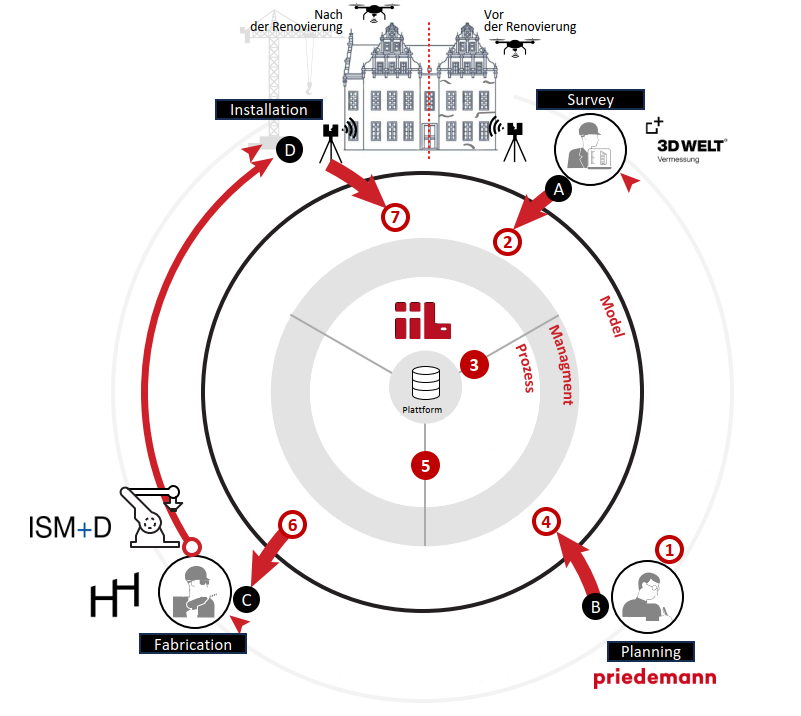
Process map

Move over a process area to highlight the corresponding lifecycle step.

DenkmalBIM process
Component lifecycle

From survey record to building memory

The use case is structured around traceable component data: capture, decide, fabricate and write back.

A

Survey

Capture the existing condition

TLS, photogrammetry and photographs document the façade and detail parts. The resulting data forms the first component-level record.

B

Planning

Decide what changes

HBIM variants, damage assessment, repair decisions, tolerances and material choices are documented directly on the component.

C

Fabrication

Translate model into part

Geometry, shop drawings, CAM data, additive workflows and QA checks are linked back to the same digital component.

D

Lifecycle

Write back what happened

Installation, as-built verification and later inspections extend the twin into a long-term building memory.

Traceability: each step adds information to the same component record instead of creating disconnected files, folders or model versions.

About the use case “Charité – CBF screen façade”

The focus is a single screen-façade element of the CBF main building. The method covers three steps: (1) 3D capture and documentation, (2) 3D design with optimisation of joints, material and maintainability, (3) reproduction up to installation.

Last update

04/06/2026